An electricity meter in a town centre and a sensor placed in the middle of a field do the same job and need two different networks. IoT connectivity is a set of specialised technologies, each designed for one environment, one range and one kind of data. A small business does not need the most advanced option on paper; it needs the one that delivers the data where it is needed, for as long as it is needed, at a sustainable cost.
The global picture measures three distinct families. Low-power cellular networks, NB-IoT and LTE-M, passed 1 billion active connections at the end of 2025, according to the GSMA. The open LoRaWAN standard reached 125 million devices deployed, with a 25% compound annual growth rate, according to the LoRa Alliance. Satellite IoT, the newest family, stood at 7.5 million connections in 2024, with forecast growth of 26% a year to 2030 according to IoT Analytics. The three figures show that connected devices are already a mass infrastructure on terrestrial networks, while satellites remain a complement for what those networks cannot reach. The value these devices generate has shifted from hardware to services, as the figures for the Italian IoT market show.
LPWA networks for devices beyond coverage
Low-power wide-area networks, known by the acronym LPWA, were designed to keep devices running for years on a battery while transmitting small amounts of data from places where the traditional cellular signal is weak or absent. Several technologies sit under that label, with different origins and uses.
NB-IoT, the narrowband cellular variant, serves fixed sensors in difficult environments: basements, underground spaces, warehouses with metal structures, large fields. It sends very small packets and focuses on battery life and signal penetration. LTE-M, the other cellular variant, supports moving devices, higher speeds and over-the-air firmware updates, so it fits asset tracking and vehicles on the move. LoRaWAN, an open standard independent of mobile operators, lets a company build its own network with its own gateways and keep control of the data it collects. These devices typically run for more than ten years on a battery.
In Italy the ground is ready. Since 2020 the law has allowed the installation and operation of LPWA concentrator equipment under a general authorisation, removing the time limits that had held back investment. The most recent step is the guidance adopted by the Ministry of Enterprises and Made in Italy together with the Ministry of Defence on 4 March 2026, in force since 1 June 2026. For a company assessing a sensor network, a project and a supplier able to meet the requirements are enough.
Sigfox belongs to the same family, now marketed as Sigfox 0G after the brand passed to UnaBiz; in Italy the network is run by a dedicated national operator. It offers very wide coverage and minimal data volumes, suited to simple alerts. For a new project it deserves caution, because the strength of its industrial path over the medium term is less documented than that of LoRaWAN and NB-IoT: when connectivity has to last as long as the plant, the choice of supplier matters as much as the protocol.
Satellites enter IoT connectivity
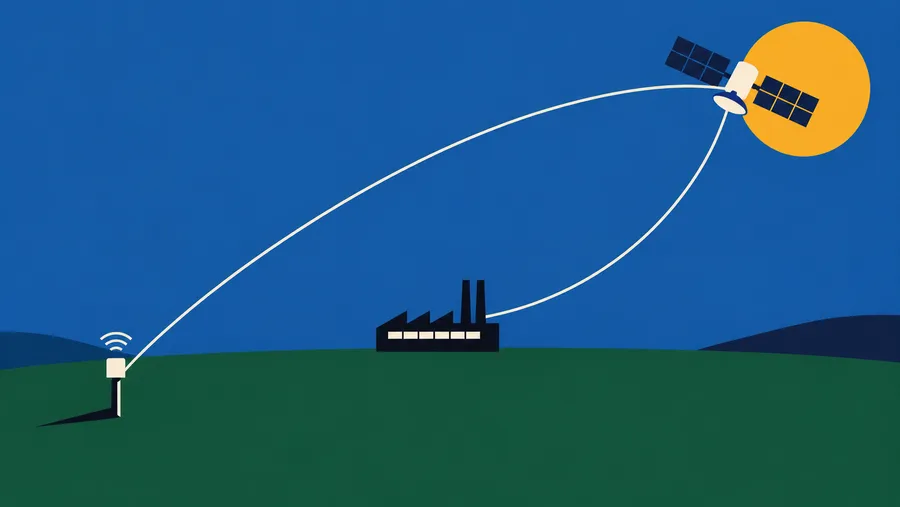
For decades satellites were a niche solution, with expensive terminals and limited bandwidth. Integration with cellular standards changed the picture. The 3GPP, the body that defines mobile network specifications, introduced satellite access for NB-IoT and low-power cellular technologies in Release 17, with optimisations in Release 18 and a dedicated work item in Release 19. The shorthand for this line is IoT-NTN, where NTN stands for non-terrestrial network: the device speaks the same language as the cellular network, but the signal travels to a satellite in low Earth orbit.
On the industrial side, the steps are recent and verifiable. Kineis, a French operator, completed a constellation of 25 nanosatellites dedicated to IoT in March 2025 and launched its service on 1 June 2025. In November 2025 the European Space Agency, with Eutelsat and other partners, completed the first 5G-NTN connection over OneWeb satellites in low Earth orbit, using Release 19 specifications. On public European connectivity, the IRIS² programme signed its implementation agreement in August 2026 and plans 348 satellites; in September 2026 ESA started eighteen study contracts for Low-LEO services, with first in-orbit validation expected between 2027 and 2029.
On the commercial side, Vodafone IoT and Skylo announced in January 2026 a partnership to offer satellite NB-IoT connectivity over a single SIM, able to switch from the cellular network to the satellite when the terrestrial one is unavailable. The service is at trial stage. Satellite IoT remains a concrete frontier, still far from the scale of terrestrial networks. Satellite IoT connections stood at 7.5 million in 2024, against one billion low-power cellular connections. Module and subscription costs weigh more than on terrestrial networks, and the return depends on the value of the data. Satellites make sense where no terrestrial network can collect the data and where that data is worth enough to justify the cost.
Four criteria guide the choice of network
The choice starts from the constraints of the project. The first is effective coverage, measured where the device actually works: a sensor in a basement or behind a concrete wall can be unreachable even in a city centre. The second is data volume and frequency: an alarm that fires a few times a year and a reading every five minutes need different networks and carry different costs. The third is power: if the device has to last ten years without maintenance, battery life decides instead of speed. The fourth is total cost and degree of control: subscription per device, international coverage, the option to run a private network, dependence on a single supplier. Total cost includes items that never appear in the initial quote, as happens with the hidden costs of digital transformation.
Alongside these criteria sits the compliance profile of the product. Cybersecurity requirements for internet-connected radio equipment have applied since 1 August 2025, and the Cyber Resilience Act adds reporting obligations from 11 September 2026 and general application from 11 December 2027. Anyone who designs or resells a connected device has to treat compliance as part of the project from the start.
For a small business the network follows the process
For a small business the starting point is the decision the data has to improve. A sensor that anticipates a fault, a meter that flags abnormal consumption or a plant managed remotely delivers a benefit when it enters a defined process and a defined responsibility; the network choice comes later, and follows from where the device sits and what its data is worth.
The most common risk is organisational: the pilot that works in testing and becomes an unsustainable recurring cost when devices go from ten to a hundred, because coverage has to be verified case by case and the subscription multiplies. In the same way, a network chosen only on its initial price can prove inadequate when data volumes grow or when coverage is needed in another region.
Connectivity, like digital architecture, has to be designed before it is switched on. Anyone who puts a connected product into service and turns it into a recurring service also takes responsibility for the network that feeds it: this is the crux of the shift from product to service. What counts is the share of data that actually arrives, the cost per device per year and the real coverage at the installation sites.
Connecting a device is the simplest operation in an IoT project. The hard part is choosing the infrastructure that will stay in service for years, as volumes, sites and subscriptions change. LPWA networks have made low-power mass connectivity possible; satellites have opened places no terrestrial network reaches. What counts is where the data has to arrive and what it is worth. Everything else, including the conversation with someone who knows the integration burden a network of devices carries, follows from there.
Connectivity and processes
Where does the network choice start
A review of the devices to connect, the installation sites and the data to collect helps choose between LPWA, cellular and satellite networks.
Book a first callFrequently asked questions
What are LPWA networks?
They are low-power wide-area networks, designed to keep devices running for years on a battery while transmitting small amounts of data. They include NB-IoT and LTE-M, which travel over cellular networks, and LoRaWAN, an open standard that lets a company build its own network. They serve places where the traditional cellular signal is weak or absent, such as basements, underground spaces and large fields.
When is satellite IoT worth it compared with terrestrial networks?
When the device sits in an area no terrestrial network reaches and the data it produces has high value. Satellite is still a small family: 7.5 million connections in 2024, against one billion low-power cellular connections. Modules and subscriptions cost more than on terrestrial networks, so the return depends on the value of the data collected.
Does IoT connectivity need authorisation in Italy?
Since 2020 the law has allowed the installation and operation of LPWA concentrator equipment under a general authorisation. The guidance adopted by the Ministry of Enterprises and Made in Italy together with the Ministry of Defence on 4 March 2026, in force since 1 June 2026, completes the picture. A project can proceed under the general authorisation, with a supplier able to meet the requirements.
Why are NB-IoT and LTE-M different?
NB-IoT is optimised for fixed sensors in difficult environments, with very small packets and maximum battery life. LTE-M supports moving devices, higher speeds and over-the-air firmware updates, so it fits asset tracking and vehicles on the move. The choice between them depends on where the device sits and how much data it has to transmit.
How do you tell whether the chosen connectivity is adequate?
It comes down to the share of data that actually arrives, the cost per device per year and the real coverage at the installation sites. A high declared speed does not make up for a sensor that stays unreachable or a subscription that grows with the number of devices. The check has to be done in the field, before extending the project.
Sources
GSMA — *Over one billion LPWAN connections*, data at the end of 2025: https://www.gsma.com/solutions-and-impact/technologies/internet-of-things/billion-lpwan-connections/
LoRa Alliance — *LoRa Alliance Reports 125 Million LoRaWAN End Devices Deployed Globally*, 10 December 2025: https://resources.lora-alliance.org/home/lora-alliance-reports-125-million-lorawan-end-devices-deployed-globally
3GPP — *5G Non-Terrestrial Networks*, IoT-NTN specifications (Release 17, 18 and 19): https://www.3gpp.org/news-events/3gpp-news/5g-ntn
Osservatorio Internet of Things, School of Management, Politecnico di Milano — *Internet of Things (IoT) in Italia: il mercato cresce del 12%*, 16 April 2026: https://www.osservatori.net/comunicato/internet-of-things/internet-of-things-italia-mercato/
European Commission and European Space Agency — *Netherlands hosts first 5G-advanced non-terrestrial network connection via OneWeb satellites*, 17 October 2025: https://digital-strategy.ec.europa.eu/en/miscellaneous/netherlands-hosts-first-5g-advanced-non-terrestrial-network-connection-oneweb-satellites-european
European Space Agency — *IRIS² reinforced and accelerated as implementation advances*, 7 August 2026: https://www.esa.int/Applications/Connectivity_and_Secure_Communications/IRIS2_reinforced_and_accelerated_as_implementation_advances
European Space Agency — *ESA starts next phase of IRIS² evolution through Low-LEO activities*, 17 September 2026: https://www.esa.int/Applications/Connectivity_and_Secure_Communications/ESA_starts_next_phase_of_IRIS2_evolution_through_Low-LEO_activities
Kineis — *Kineis completes the deployment of its IoT Constellation and prepares for service launch*, 18 March 2025: https://kineis.com/en/successful-5th-launch-for-the-kineis-constellation/
IoT Analytics — *Satellite IoT market projected to grow at a CAGR of 26%, reaching $4.7 billion by 2030*, 17 June 2025: https://iot-analytics.com/wp-content/uploads/2025/06/INSIGHTS-RELEASE-Satellite-IoT-market-growth-and-outlook.pdf
Vodafone IoT and Skylo — *Skylo partners with Vodafone IoT to bring NTN NB-IoT satellite connectivity to customers*, 28 January 2026: https://www.skylo.tech/newsroom/skylo-partners-with-vodafone-iot-to-bring-ntn-nb-iot-satellite-connectivity-to-customers
EUR-Lex — Delegated Regulation (EU) 2022/30, cybersecurity requirements for radio equipment, applicable from 1 August 2025: https://eur-lex.europa.eu/eli/reg_del/2022/30/oj/eng
EUR-Lex — Regulation (EU) 2024/2847 (Cyber Resilience Act), reporting obligations from 11 September 2026: https://eur-lex.europa.eu/eli/reg/2024/2847/oj/eng
Ministry of Enterprises and Made in Italy — *Decreto interministeriale 4 marzo 2026 — Linee Guida per l'installazione o esercizio di apparati concentratori in tecnologie LPWAN*: https://www.mimit.gov.it/it/normativa/decreti-interministeriali/decreto-interministeriale-4-marzo-2026-linee-guida-per-linstallazione-o-esercizio-di-apparati-concentratori-in-tecnologie-low-power-wide-area-network-lpwan
Normattiva — Legge 11 settembre 2020, n. 120, conversion of decreto-legge 16 luglio 2020, n. 76 (Decreto semplificazioni): https://www.normattiva.it/uri-res/N2Ls?urn:nir:stato:legge:2020;120