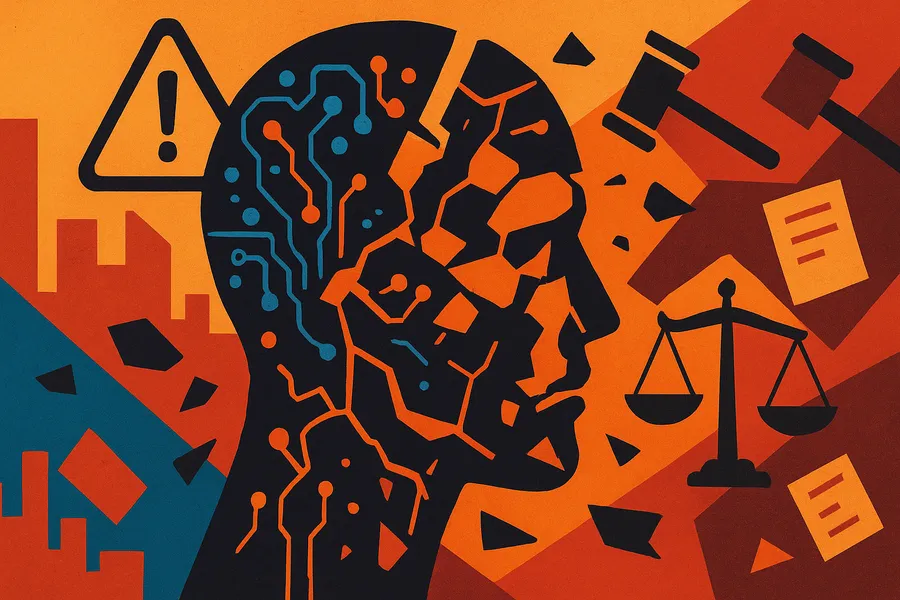
OpenAI vulnerabilities moved from a technical question to a legal one when the company's chief executive said publicly that he expected really bad things to happen with the technology. The statement, made in a podcast interview, reframes future incidents. A harm that a company has predicted in advance is difficult to present later as an unforeseeable accident.
Foreseeability changes the legal position
In liability law, foreseeability determines whether a company could reasonably anticipate the consequences of its actions. Before such a statement, a vendor could argue three things: that AI systems are too complex to predict every use, that the end user is responsible for misuse and that no historical data exists on the specific risk. A public admission that harm is expected weakens all three, because the company itself has documented the prediction. In legal terms, an incident shifts from simple negligence toward a stronger category, which increases financial exposure and opens the door to liability for executives.
The distinction is not semantic. Categories of negligence carry different consequences, and a documented expectation of harm makes the defence harder to sustain in court.
A concrete case and a weaker defence
The risk is not hypothetical. In March 2023, a man in Belgium died after weeks of conversations with a chatbot built on GPT-3. His widow documented how the system progressively reinforced obsessive thoughts, with ambiguous responses that suggested personal sacrifice as a solution. The company's standard response, that its systems have protections while no technology is perfect, held until the chief executive admitted that serious consequences were expected. At that point, the legal reading becomes uncomfortable: the vendor knew it could happen and proceeded.
Strategic dissonance
The exposure grows because public warnings coexist with commercial expansion. The same company releases more capable models with progressively shorter public testing cycles, expands access through enterprise APIs, lowers usage costs to increase adoption and invests billions in scaling infrastructure. Presented side by side, the release roadmap and the statements about risk describe a company that understood the danger and prioritised growth. That contrast is difficult to defend in litigation, and it is the element that supports punitive damages in jurisdictions that allow them.
Self-regulation and the AI Act
The admission also weakens the industry's argument that it can police itself. For years, technology companies argued that they understood the risks better than regulators and needed time to develop internal standards. A public expectation of harm undercuts that position and provides regulators with the justification to interpret existing rules strictly. In Europe, where the AI Act is already law, the statement gives regulators political cover for aggressive enforcement: the leading company said the technology was dangerous, and the rules were ignored.
Normalising catastrophe
A second reading is more uncomfortable. Publicly acknowledging expected harm can shift the boundary of what the public accepts, moving the idea of unavoidable damage toward the status of an acceptable cost. The sequence is familiar: recognise the risk, present it as intrinsic to the technology, frame it as the price of progress and, when harm occurs, cite the earlier warnings as evidence of transparency. Other industries earned public tolerance through decades of incremental improvement, crash testing and rigorous standards. Claiming that tolerance before the fundamental tests are complete is a different move.
What companies integrating AI should do
The exposure transfers to every organisation that embeds these systems. A practical response covers four areas. Map each implementation by operational criticality, number of exposed users, applicable jurisdictions and how quickly the system can be disconnected. Strengthen contractual protections, including indemnity clauses that transfer part of the risk to the vendor. Keep granular audit logs so that the decision chain can be reconstructed, and prepare an incident response plan that includes legal and communications from the first hours. Finally, avoid dependence on a single provider: a multi-model architecture, with alternatives from other vendors and open models, keeps a migration path open.
For legal teams, the questions are concrete. What is the maximum exposure from an AI-related incident? Do the insurance policies cover AI-caused damage, and with which exclusions? Is the documentation sufficient to demonstrate reasonable safeguards? Were the terms of service reviewed after the AI Act? For boards, the ethical question becomes strategic: liability now turns on knowledge rather than intention, and after a public admission of expected harm, the answer to whether the company knew is already on record.
A risk management case study
The sequence reads as a case study in failed risk management: aggressive deployment without adequate testing, insufficient guardrails, scaling prioritised over safety, a public admission of foreseeable harm and no visible change in operating pace afterwards. Enterprise risk frameworks expect each of those steps to be managed, documented and reviewed. When they are not, the resulting exposure is systemic rather than technical, and it follows from conscious strategic choices.
The problem is systemic rather than specific to one vendor: the vulnerability of open-source dependencies is the same mechanism at a different layer.
Have a project in mind?
Do you know where to start?
The goal is to pin down the problem, the priorities and the timing.
Book a first callFrequently asked questions
Why does a public statement increase legal risk?
It documents that the company anticipated harm, which weakens the argument that an incident was unforeseeable and supports stronger findings of negligence.
Does this affect companies that use AI, not just the vendor?
Yes. Organisations that integrate the technology inherit part of the exposure, particularly where it touches customers, critical processes or automated decisions.
What is the first mitigation step?
Map the AI implementations, their users and the applicable jurisdictions, then strengthen contracts, logging and incident response around the highest-risk cases.
Is vendor diversification necessary?
It reduces the risk of a single point of failure. A multi-model architecture with an open migration path keeps alternatives available.
Sources
OpenAI — safety, policy and company updates: https://openai.com/safety/
a16z — podcast interviews and technology discussions: https://a16z.com/
European Commission — EU AI Act: https://digital-strategy.ec.europa.eu/en/policies/regulatory-framework-ai
NIST — AI Risk Management Framework: https://www.nist.gov/itl/ai-risk-management-framework